Solving the Mysteries of Quantum Tunneling
Introduction
Quantum tunneling is a fascinating quantum phenomenon where a particle can pass through a barrier that it classically shouldn't be able to cross.
A simple everyday analogy: Imagine throwing a ball at a solid wall. Normally, it just bounces back. But in quantum tunneling, there's a tiny probability that the ball could somehow go straight through the wall and appear on the other side without breaking it!
A Real Physics Example: The Step Potential Barrier
In labs, scientists create a "potential barrier" – think of it as a hill of energy (height V₀) that a particle has to climb.
Classically:
- If the particle's kinetic energy E is greater than V₀, it goes over the barrier easily.
- If E < V₀, it bounces back. No way to cross!
But quantum mechanics says something wild: Even if E < V₀, there's a small chance the particle tunnels through and appears on the other side.
The particle's wave function (which describes its probability of being found at different places) spreads into and through the barrier. To us, it looks like the particle vanishes on one side and instantly reappears on the other.
- In atomic nuclei, alpha particles (during radioactive decay) tunnel out of the nucleus.
- Electrons in atoms can tunnel around the nucleus, even though the probability of finding them exactly at the nucleus is zero.
The Big Confusion
Inside the "forbidden" region (where the potential V₀ > E), if the particle is there, its kinetic energy would seem to be negative:
Kinetic Energy = Total Energy E – Potential Energy V₀
→ KE = E – V₀ < 0
Negative kinetic energy? That's impossible in classical physics! It would mean imaginary velocity (since KE = ½mv²). Everything seems broken!
Clearing Up the Contradiction
The key is the Heisenberg Uncertainty Principle.
In the forbidden region, the particle's position is highly uncertain (the wave function is spreading out but decaying exponentially). Because of uncertainty in position (Δx is small in a narrow barrier, but the measurement is tricky), there's a large uncertainty in momentum (Δp).
This leads to uncertainty in energy (ΔE).
When you actually measure the particle's energy inside the barrier, the uncertainty ΔE is large enough that you'll always measure a total energy greater than V₀ – meaning positive kinetic energy.
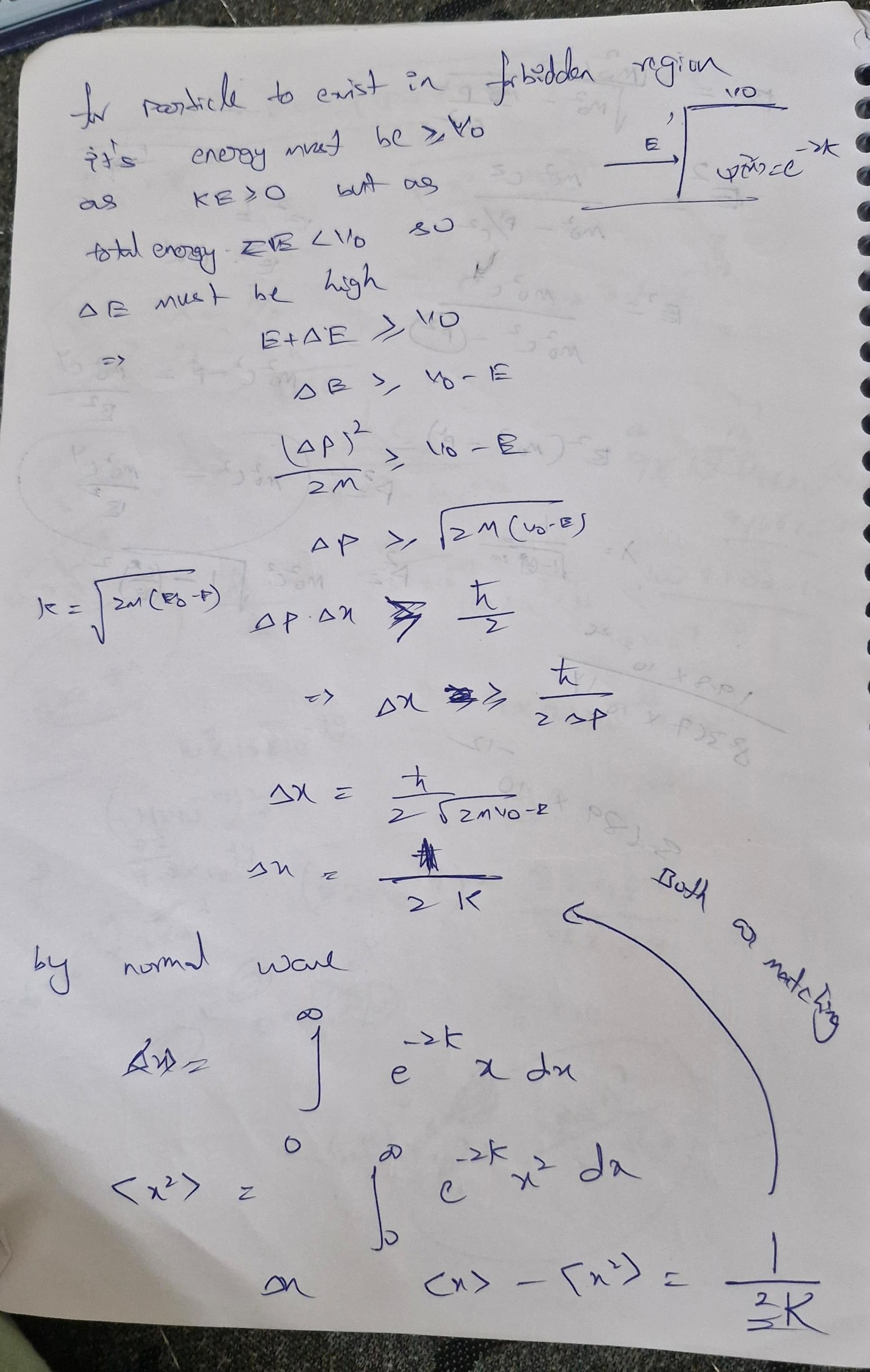
- ΔE must be at least V₀ – E to "borrow" enough energy.
- Using the uncertainty principle: Δp² / 2m ≥ V₀ – E
- Then deriving the barrier width Δx ≈ ℏ / (2 √[2m(V₀ – E)])
Tunneling probability drops exponentially with thicker or higher barriers.
In short: The particle doesn't really have negative kinetic energy. The act of being in the forbidden region requires energy uncertainty that makes the measurement always show positive KE.